
Ripley's Story — When Your Cat Has Pemphigus
It started with a scab on Ripley's face that wouldn't heal.
I thought she'd scratched herself. Then it came back, and another one showed up near her ear, and the spot on her head she used to shove into my hand became a spot she pulled away from. That was the part that scared me before I had any word for what was happening—my aggressively affectionate cat, flinching.
The word, when we finally had it, was pemphigus foliaceus. It's an autoimmune skin disease. Her own immune system had decided her skin was the enemy and started attacking it, raising crusts and sores wherever it struck. Nothing caused it—no allergy, no infection I could clear up, nothing I did wrong. It's just something her body does now. There's no cure. There's only managing it.
I'm not a vet, and this isn't medical advice. Every cat and every case is different, and yours needs your own vet—honestly, probably a veterinary dermatologist. This is just what it's been like from my side of it: the owner's chair.
The fight wasn't the disease. It was the medicine.
This started in September of 2025. It's July now. And for most of that stretch, the hardest part of my day wasn't the pemphigus. It was getting the medicine into a cat who wanted no part of it.
We tried everything. Hiding it in her food. Pills. Compounded treats formulated just for her. When none of that worked, I gave it to her straight, or sandwiched in a little churu and eased from a syringe. Atopica was the worst of them—she would scream, she would hide from me for hours afterward, and more than once she was so frightened that she lost control of herself right there in my hands. I'd clean her up, hate myself for a while, and do it again the next day, because the next day isn't optional when your cat is sick.
And it didn't even seem to be working. She'd been on steroids so long that her blood sugar started creeping toward diabetic, and we had to pull her off them—one more thing that was supposed to help, taken away. Nothing was holding.
The worst part wasn't the sores, or the mess, or the money. It was that she stopped trusting me. She hid when she saw me coming. To her, I'd stopped being the person who loved her and turned into the person with the syringe—and I couldn't explain it to her. That was the hardest part of the whole thing.
What finally turned it around
Switching to Apoquel is what changed things—not overnight, and not just because the medicine got easier. She didn't hand my trust back the moment the fight got smaller. It took time. But it got better.
And the thing that genuinely saved us was treats. She won't take them on their own, but they crush up and vanish into her favorite treat like they were never there.
Here's where we are now, and I still can't quite believe I get to type it: Apoquel twice a day, chlorambucil every other day—and she takes all of it without a fight. No screaming. No hiding. Just a cat and a snack. What works for her isn't a prescription for yours—that's your vet's call—but after the year we had, a cat who lets me help her is not a small thing. It's everything.
Where we are now
Her skin caught up with the rest of the good news. As I write this, Ripley has been scab-free for weeks. I won't call it cured, because pemphigus doesn't really do cured—but it might be remission. We see her dermatologist again in August, and I'm letting myself hope we can start tapering the meds down. I'm trying not to hope too hard. But a little.
Through all of it, she stayed herself. Ripley is aggressively affectionate—when she feels good she is a lot of cat, all shove and purr and opinion—and pemphigus never took that from her. It buried it for a while, under the fear and the syringes. It didn't erase it. She came back. She still comes for the affection; she's only choosier now about where my hands land.
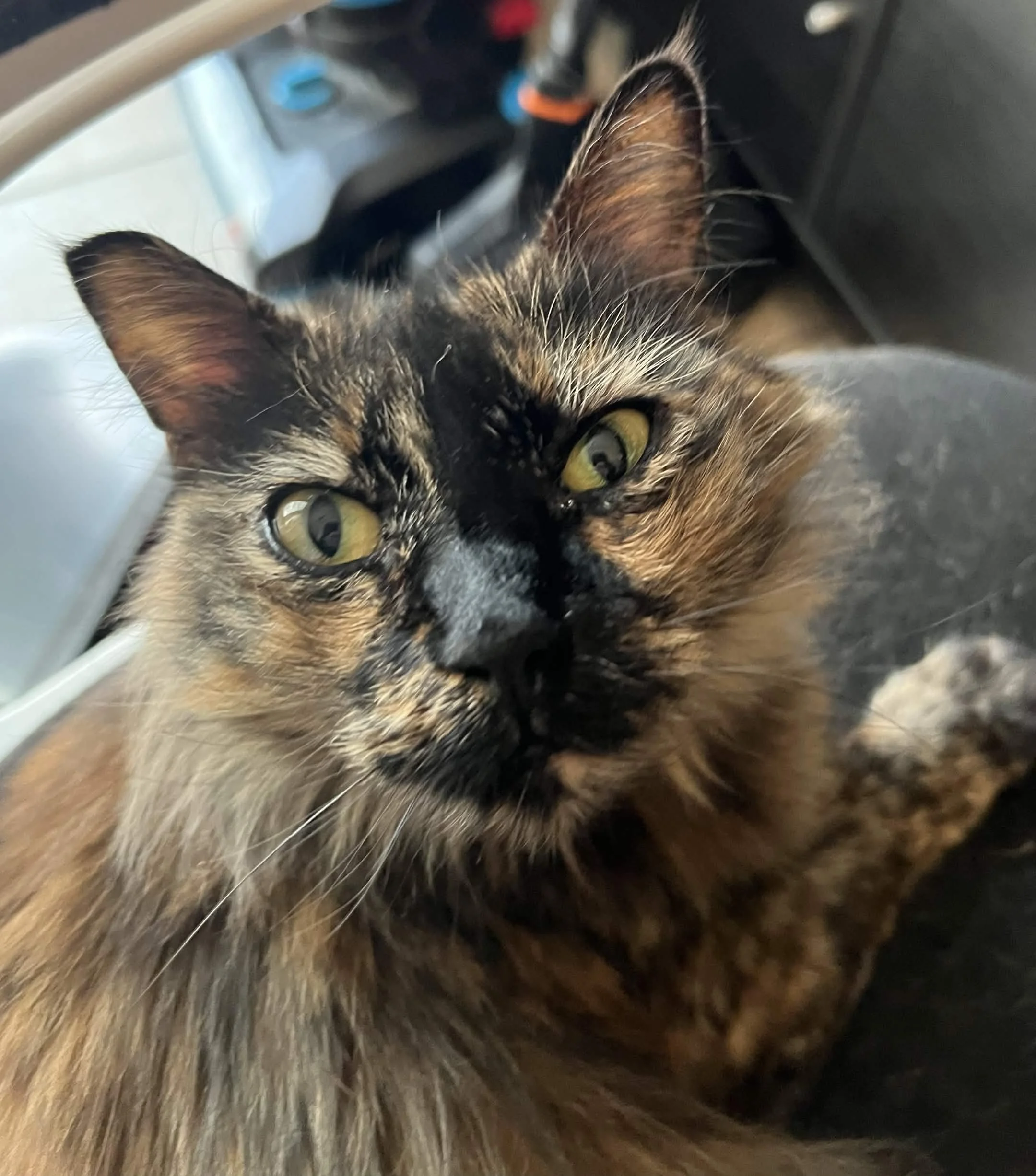
This is Ripley. Being a lot of cat.
Why I wrote a whole book about it
I write cat fiction under the name Kysa Steele, and somewhere in the middle of all this I did the only thing I know how to do with a feeling I can't fix: I wrote it down. Handle with Care is Ripley's story told slantwise—a witch's familiar named Missi whose own magic turns on her skin, and the witch who quietly carries the fear and the research and the cost so her cat doesn't have to. It's fiction, but the heart of it is true. It's the truest thing I've written.
If your cat was just diagnosed and you found this by searching in the dark at 2 a.m.: I'm sorry. You're not alone. The medicine fight can get easier, the trust can come back, and it can get better even when it doesn't get cured.
Want to follow how Ripley's doing—including what the dermatologist says in August? I send real cat updates (and book news) in my newsletter. And if you'd like the story I made out of all this, Handle with Care is in ebook and paperback—signed paperbacks direct from me, where a bigger share goes to, fittingly, the vet bills.
