
Standalone Stories
Handle with Care
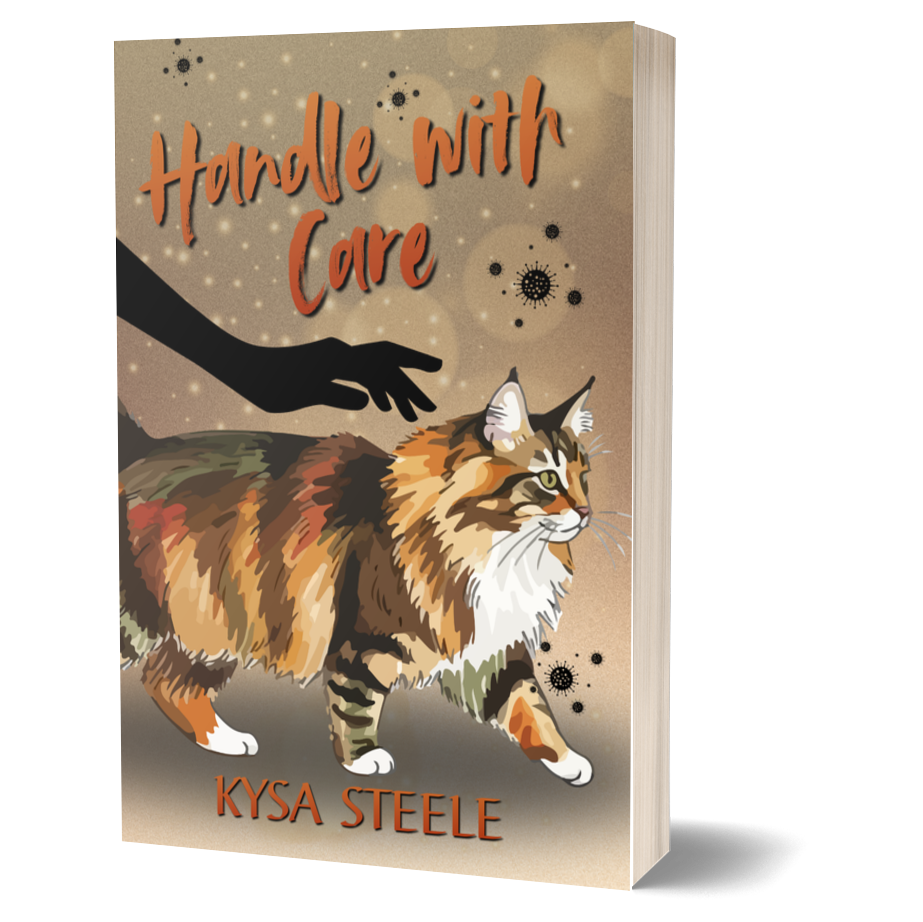
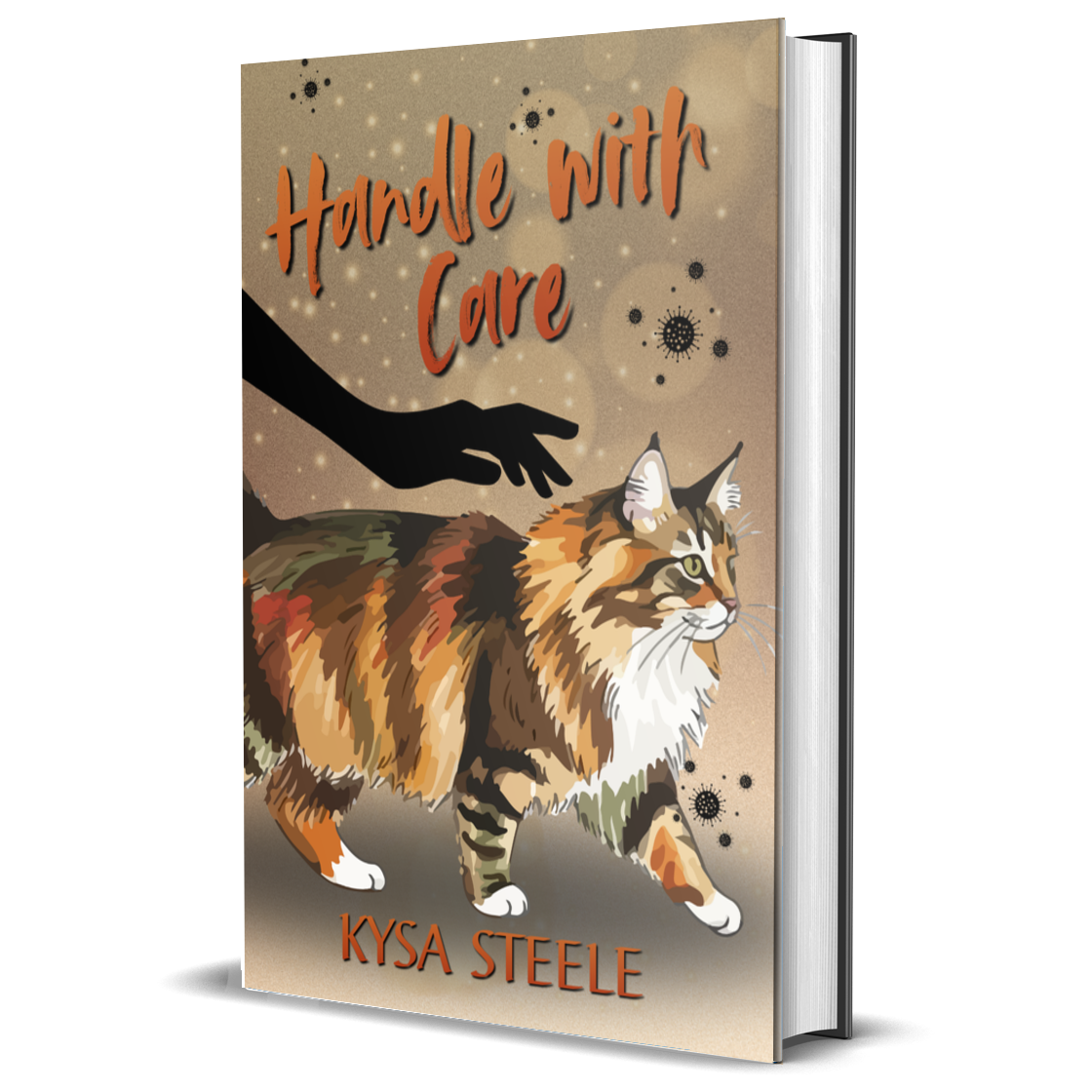
Missi has a good life. She has her witch, her brother, her spot on the back of the chair, and a demanding opinion about when pets should happen. She survived kittenhood in dangerous places, lost siblings, got passed over by another witch who didn't want her. But she found home. She's content.
Then her face starts to hurt.
At first it's small—a sore spot she keeps licking, a scab that won't heal. Her witch notices. There are trips to the healer, potions that taste terrible, words Missi doesn't understand spoken in worried tones over her head. She doesn't know what's wrong. She only knows that something has changed, and the pets she used to demand now make her flinch.
Her magic has turned traitor. A flaw she was born with, dormant until now, has woken. Her own power treats her skin as the enemy—attacking, blistering, refusing to let her heal. It's not a curse anyone cast. It's just what her body does now.
What follows isn't a battle. There's no villain to defeat, no cure to quest for. There's only the long, unglamorous work of figuring out how to live. Treatments that don't work. Treatments that work for a while and then stop. Good days that feel like gifts. Bad days that feel like betrayal. A witch who absorbs the fear and the research and the financial strain so Missi doesn't have to carry it alone—even though Missi doesn't fully understand what her human is doing or why.
Through it all, Missi stays herself. Opinionated. Dignified. Frustrated when her body won't cooperate. Confused when routines keep changing. Still demanding affection, even when she has to be careful about how she receives it. Her brother stays close—a warm presence when everything else feels wrong.
The resolution isn't triumphant. It's quieter than that. A medication that finally seems to hold. A stretch of days where nothing gets worse. The slow realization that this is life now—different, careful, requiring adjustments—and life can still be good.
🖊️ All copies come signed by the author.
Missi has a good life. She has her witch, her brother, her spot on the back of the chair, and a demanding opinion about when pets should happen. She survived kittenhood in dangerous places, lost siblings, got passed over by another witch who didn't want her. But she found home. She's content.
Then her face starts to hurt.
At first it's small—a scab that won't heal. Her witch notices. There are trips to the healer, potions that taste terrible, words she doesn't understand spoken in worried tones. She doesn't know what's wrong. She only knows that something has changed, and the pets she used to demand now make her flinch.
Her magic has turned traitor. A flaw she was born with, dormant until now, has woken. Her own power treats her skin as the enemy—attacking, refusing to let her heal. It's not a curse anyone cast. It's just what her body does now.
What follows isn't a battle. There's no villain to defeat, no cure to quest for. There's only the long, unglamorous work of figuring out how to live. Treatments that don't work. Treatments that work for a while and then stop. A witch who absorbs the fear and the research and the financial strain so Missi doesn't have to carry it alone—even though Missi doesn't fully understand why.
Through it all, Missi stays herself. Opinionated. Dignified. Frustrated when her body won't cooperate. Still demanding affection, even when she has to be careful about how she receives it. Her brother stays close—a warm presence when everything else feels wrong.
The resolution isn't triumphant. It's quieter than that. A medication that finally seems to hold. A stretch of days where nothing gets worse. The slow realization that this is life now—different, careful—and life can still be good.
-
The sun finds me first.
Of course it does. The window faces east, the chair sits where the light pools, and here I am. The fabric holds my shape—a shallow bowl worn into the cushion from a hundred naps, a thousand afternoons, all the slow hours spent soaking in warmth while dust drifted through the light.
I stretch. Back legs first, driving against the armrest until claws snag the weave. Then the front. Spine arching. A long pull of muscle and fur. I am awake. The day can begin.
The kitchen smells like static and burned toast. The Witch is standing at the counter, back to me, but I know what she's doing. I can hear the tink-tink-tink of the metal spoon against ceramic. She isn't holding it. She never does before her first cup.
I trot in, tail held high. The air in here feels thick—like the sky right before a storm breaks. It makes my whiskers twitch.
"Morning, Missi," she says. She doesn't turn around. She doesn't have to.
The kettle on the stove screams, then cuts off abruptly as she flicks a finger. The water lifts itself—a shimmering, steaming ribbon—and pours perfectly into the mug. No splashes. I weave between her ankles. Enough with the floating water. The bowls. Look at the bowls. They are empty. A tragedy. An oversight of criminal proportions.
"Alright, alright," she sighs.
She reaches for the cabinet—not the handle, just the air in front of it. The wood groans, the latch clicks, and the heavy bag of kibble slides out, drifting down to the counter with the grace of a falling feather. I respect the efficiency, mostly. It gets the food into the bowl faster. She snaps her fingers. The bag splits. The kibble rains down—_clatter-clatter-clatter_—filling the ceramic dishes.
Only then does she pick up her mug. The spoon stops spinning and drops onto the counter with a wet clatter. The static fades. The air goes back to smelling like regular morning dust and coffee. Magic is useful, I suppose. But it doesn't taste like anything.
Jake is finishing breakfast in his spot behind the water bowl, where he thinks he's invisible. I don't need to look. I know the sound of his chewing—quick, nervous bites, glances flicking to the door, to the shadow in the corner that has never been anything but a shadow.
Jake is afraid of everything. Loud noises. Unfamiliar smells. His own reflection, if the light catches wrong. An orange giant terrified of the world. I was the scared one when we were kittens—he was the brave one. Somewhere along the way, we traded.
-
First, the Steroid. Back to 1.0. Missi knows this one. She hates it, but she swallows the fishy sludge with grim resignation. One enemy she's learned to tolerate.
Then, the new one.
I shake the bottle. I draw up the clear oil. It smells like rancid chemicals—sharp, medicinal, wrong. I hold Missi tight. I have wrapped her in a towel—a "burrito," the Healer called it—so she can't claw me. She is tense against my chest, body rigid. Her nose twitches toward the bottle.
"I'm sorry," I whisper. "I'm so sorry."
My hands are shaking. I have to grip the syringe harder to keep it steady.
I squirt the oil into her mouth.
The reaction is instant. Missi gags. She throws her head back. She doesn't swallow; she shakes her head violently, spraying droplets of oil onto my shirt, onto my face, onto the wall behind me.
Then comes the foam.
Thick, white bubbles erupt from her lips. Long, stringy ropes of saliva hang from her jaw, dripping onto the towel, onto her paws, onto the floor. She is drooling like a rabid beast, her mouth working frantically to get the taste out. Her eyes are huge, whites showing. Her body convulses with each gag.
"It's okay!" I grab a tissue. I try to wipe her mouth, but the foam keeps coming. "It's just the taste, Missi! It's okay!"
She wrenches free from the towel. She runs.
She runs to the rug and drags her face across it, leaving a snail-trail of slime. She runs to the kitchen and shakes her head, flinging white foam onto the cabinets. She runs in circles, gagging, pawing at her mouth.
I stand there, the empty syringe in my hand.
I did this. I held her down and I did this to her. The Healer called it a taste response. It looks like a seizure. She said it looks worse than it is. It looks like torture. She promised it works. I watch my cat drag her face across the floor, and I pray she wasn't lying.
This is what helping looks like. This is what love looks like. This is what I have to do every single day for the next two weeks, maybe three, maybe longer.
I smell the oil on my fingers. I go to the sink. I wash my hands. I wash them again. The smell won't come off.
-
Paperback: ### pages | ISBN ###
Hardcover: ### pages | ISBN ###
Ebook: Available on AmazonPublished Month 2026
-
Kysa Steele
The Cat That Time Built
🖊️ All copies come signed by the author.
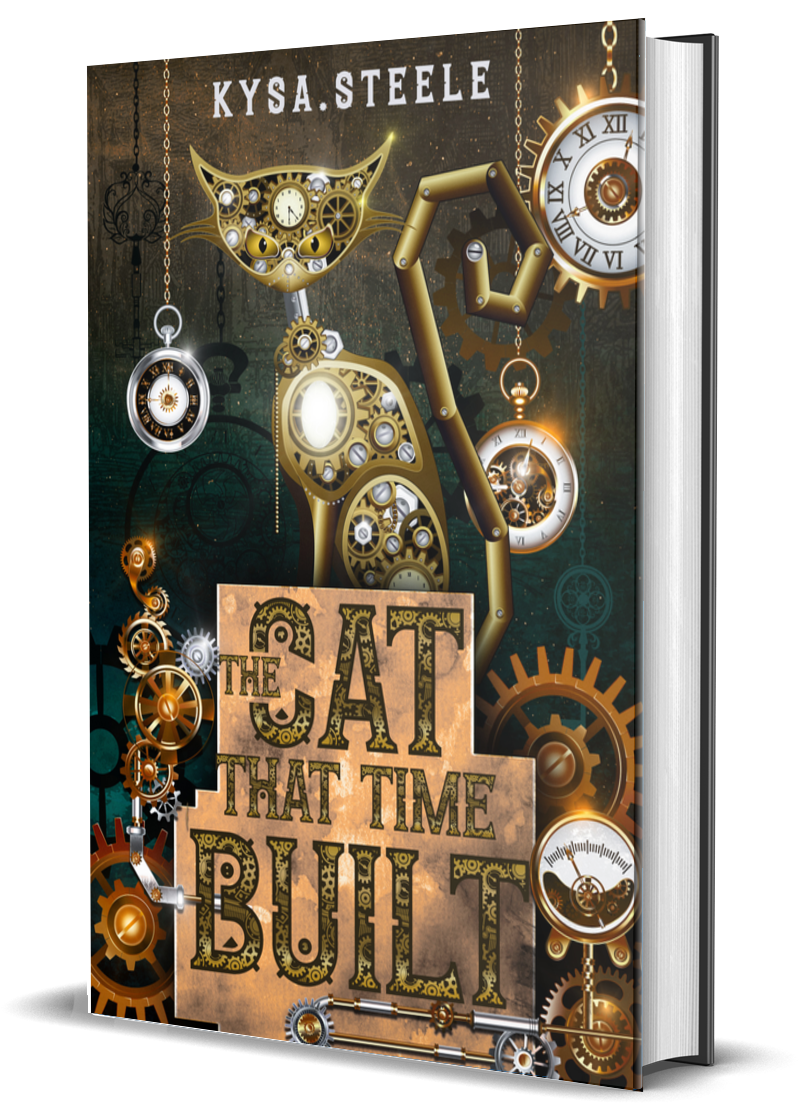
London, 1742. A clockmaker buries his daughter and builds something to bring her back.
What he creates is a cat—brass and gears and velvet paws, powered by a tarnished silver locket that holds the last trace of a dead girl's soul. It is beautiful. It is alive. And its love is a poison it doesn't yet understand.
The Cat That Time Built follows a clockwork automaton across three centuries of London's darkest streets—from plague-ravaged workshops to the tunnels beneath Victorian slums to the cold laboratories of the electric age. Through it all, one question drives the story forward: What happens when the thing you were made to do destroys the people you were made to love?
This is a gothic historical fantasy about grief that won't let go, love that costs too much, and the hardest choice any creature can make—to stop.
Releases October 2026
-
TBD
-
TBD
-
GetCovers
-
Paperback: XXX pages | ISBN XXX
Hardcover: XXX pages | ISBN XXX
Ebook: Available on AmazonPublished June 2026
The Cat Who Ate the End of the World
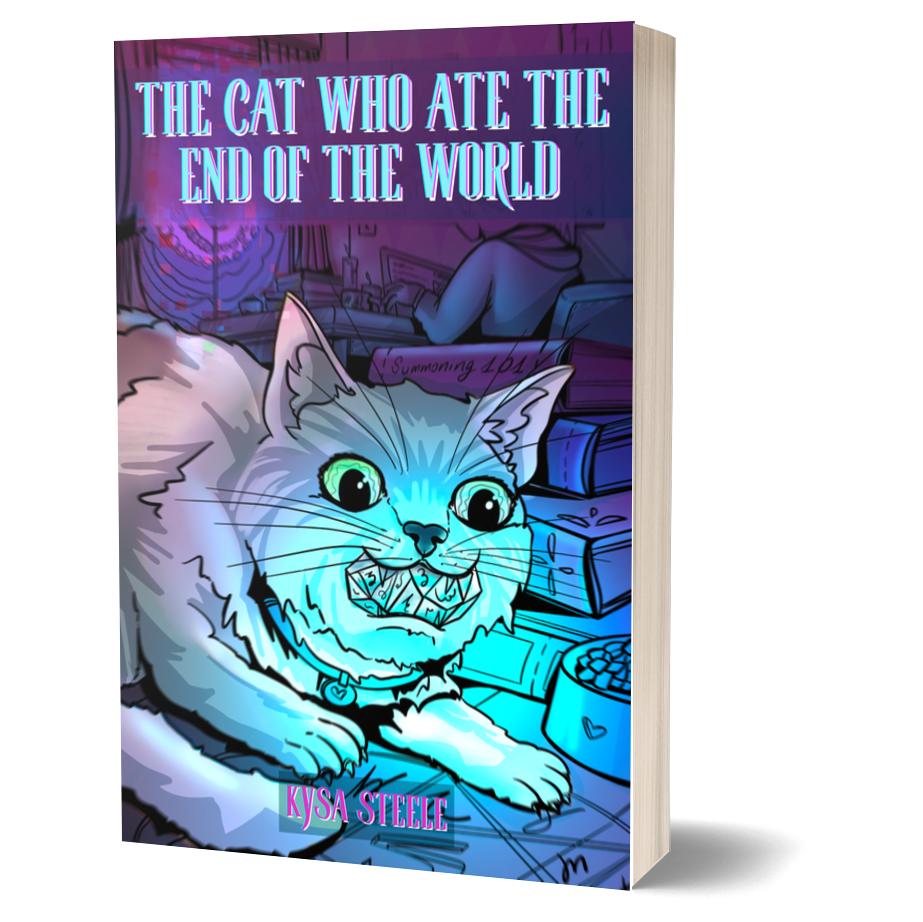
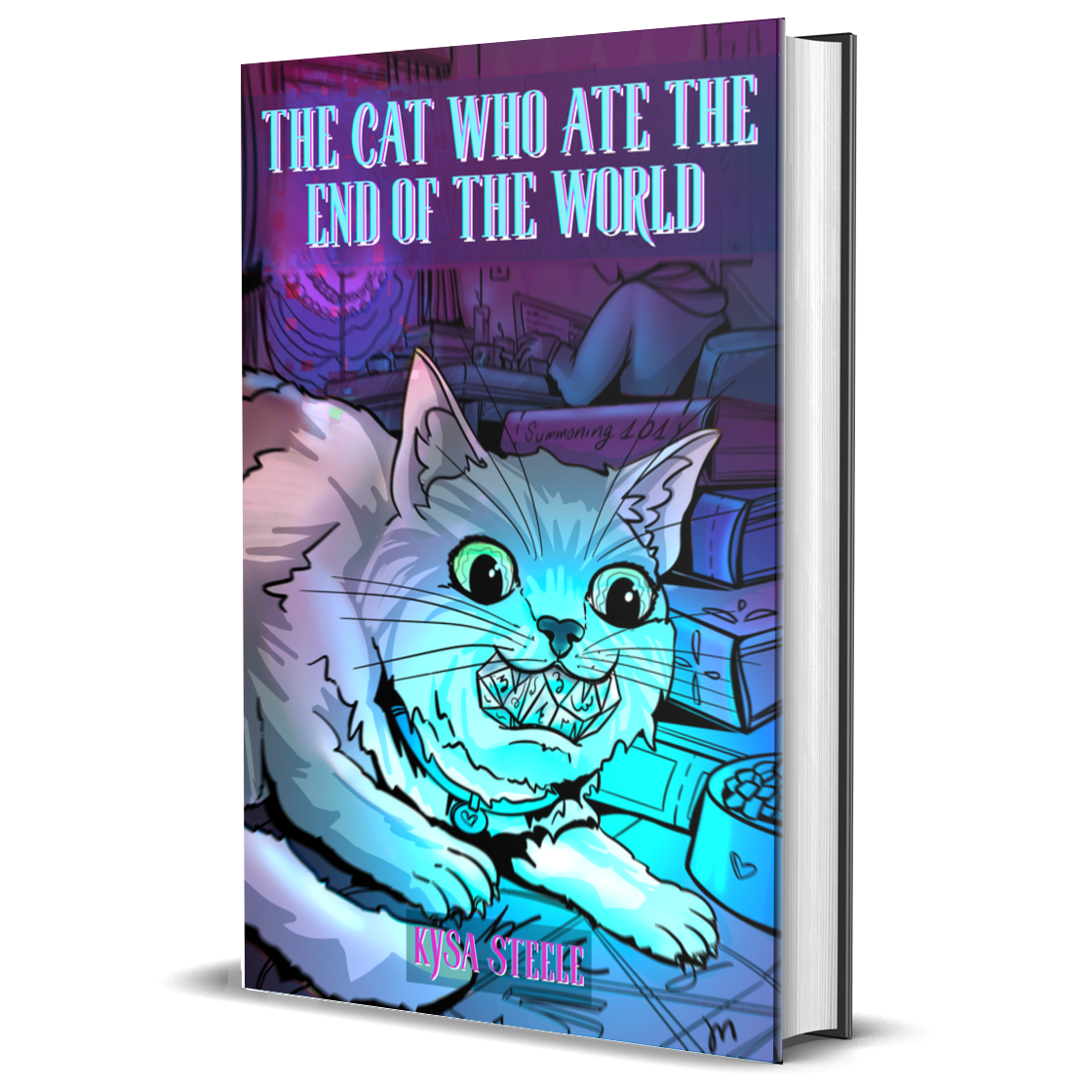
Mungus ate the end of the world. It tasted like chicken.
When Claire Pemberton's cat consumes a cosmic artifact that was supposed to be her thesis paperweight, she expects some digestive complications. She does not expect fish showers over London, traffic lights speaking ancient Sumerian, or a government committee determined to take her cat away for "containment."
Now Claire—an anxiety-ridden graduate student whose entire field nobody takes seriously—must navigate emergency bureaucracy, face down hostile treasury officials, and prove that love isn't a weakness in cosmic entity management. It's the only thing that works.
Her allies include a demon named Harold who considers paperwork a form of devotion, a government agent whose cat is learning to purr at pipes, and a professor who just discovered his thirty years of theoretical research are terrifyingly real. Her opposition includes a man who views kindness as a budget line item to be eliminated.
The committee votes. The containment order stands. And Mungus walks into a cage to protect the person he loves.
But Claire isn't done fighting.
The Cat Who Ate The End Of The World is a cozy fantasy novella about trust, bureaucratic absurdity, and the lengths we'll go to protect the ones who matter. It features:
A cosmic cat who thinks in italics about "food lady"
A demon with an enthusiasm for proper documentation
Fish showers, prophetic hamsters, and a missing Tuesday
Found family forged through crisis
The question of whether love is a sufficient basis for managing existential threats (it is)
Standalone novella. No cliffhangers. Contains one (1) deeply objectionable can of diet tuna.
🖊️ All copies come signed by the author.
Mungus ate the end of the world. It tasted like chicken.
When Claire Pemberton's cat consumes a cosmic artifact that was supposed to be her thesis paperweight, she expects some digestive complications. She does not expect fish showers over London, traffic lights speaking ancient Sumerian, or a government committee determined to take her cat away for "containment."
Now Claire—an anxiety-ridden graduate student whose entire field nobody takes seriously—must navigate emergency bureaucracy, face down hostile treasury officials, and prove that love isn't a weakness in cosmic entity management. It's the only thing that works.
Her allies include a demon named Harold who considers paperwork a form of devotion, a government agent whose cat is learning to purr at pipes, and a professor who just discovered his thirty years of theoretical research are terrifyingly real. Her opposition includes a man who views kindness as a budget line item to be eliminated.
The committee votes. The containment order stands. And Mungus walks into a cage to protect the person he loves.
But Claire isn't done fighting.
Coming March 2026
-
Mungus was a cat of simple philosophy. If it fit in his mouth, it was probably food. If it didn't fit in his mouth, it might still be food if approached from the right angle, with sufficient determination, and possibly the assistance of gravity.
This approach to life had served him well for all of his seven years, though it had led to some regrettable incidents involving houseplants, shoelaces, and on one memorable occasion, a small postal worker who had inexplicably decided to nap in the front garden.
Claire Pemberton had adopted Mungus three years ago, primarily because he was the only cat in the shelter who didn't flee when she mentioned her field of study. Most animals seemed to possess an instinctive understanding that Applied Apocalyptics was not a career path that attracted stable personalities. Mungus, however, had simply looked at her with the measured attention of someone evaluating a potential food service provider.
Food lady. Smells like books and worry. Good enough.
To Mungus, their relationship was a simple transaction of provisions. For Claire, it had evolved into a crucial partnership for her academic survival. She provided food, shelter, and a steady supply of interesting objects to investigate. He provided companionship, a warm presence during late-night thesis writing sessions, and an uncanny ability to knock expensive takeaway containers off the table at precisely the moment when Claire could least afford to reorder.
"You realize," Claire said, addressing Mungus as he began his evening patrol, "that my entire academic career is sitting on that table, weighed down by objects that Professor Blackwood says could theoretically end civilization?"
She ran a hand through her hair, feeling three years' work pressing down on her—and her mother's voice asking when she'd get a 'real job', and the department's skepticism about whether anyone should be studying apocalypses that had already happened. It was more than just a degree; it was a desperate need to prove that past civilizations hadn't just died, they had tried to warn those who came after. If she could prove that, maybe this time someone would listen. The Seal of Final Things was supposed to prove them all wrong. If she could decode its warning systems, she might finally validate her field, show that studying how civilizations destroy themselves wasn't just academic navel-gazing but practical survival knowledge.
Of course, convincing her mother that Applied Apocalyptics was practical would require a miracle. Or possibly an actual apocalypse.
From Mungus's perspective, this was just another round of mouth-sounds that didn't involve food.
Food lady making noise. Not about dinner. Continue patrol.
-
Day 28 of Containment: The International Conference
The conference room was larger than the one where Claire had lost the first vote, with screens connecting representatives from seven countries and observer delegations from a dozen more. The setup was professional, intimidating, and clearly designed for high-stakes international diplomacy.
Claire sat at the UK delegation's table, flanked by Agent Martinez and Professor Blackwood. Harold had been given official status as a "consulting administrative entity" and was positioned at a small desk with his typewriter, ready to document everything. Dr. Crumpet appeared on the main screen, attending from three temporal locations simultaneously.
Across the room, Gerald Harwick sat with a team of Treasury officials, looking confident. He had new documents, new presentations, new arguments. He had spent the last four weeks preparing his defense.
But Claire had spent four weeks preparing too.
"Ladies and gentlemen," the chairperson announced—a stern woman from the UN's Department of Impossible Situations whose nameplate read "Director Okonkwo"—"we are here to review the United Kingdom's handling of the FRCE-A7 event known informally as 'the Doomsday Cat.' Specifically, we will consider whether the current containment approach should continue, or whether alternative management strategies should be implemented."
Director Okonkwo's gaze swept the room with the authority of someone who had adjudicated disputes between supernatural entities and nation-states, and found both equally tiresome.
"I will remind all parties that this is a fact-finding session, not a debate. We are here to determine what is true, not what is convenient. Mr. Harwick, as the architect of the current policy, you may present first."
Many people. Important meeting. Food lady far away but can feel food lady fighting. Good.
-
BamberAndEmbie
https://www.etsy.com/shop/BamberAndEmbie -
Paperback: 144 pages | ISBN 978-1-971434-02-5
Hardcover: 126 pages | ISBN 978-1-971434-03-2
Ebook: Available on AmazonPublished March 2026
The Feline Guide to Surviving Your Human Workplace
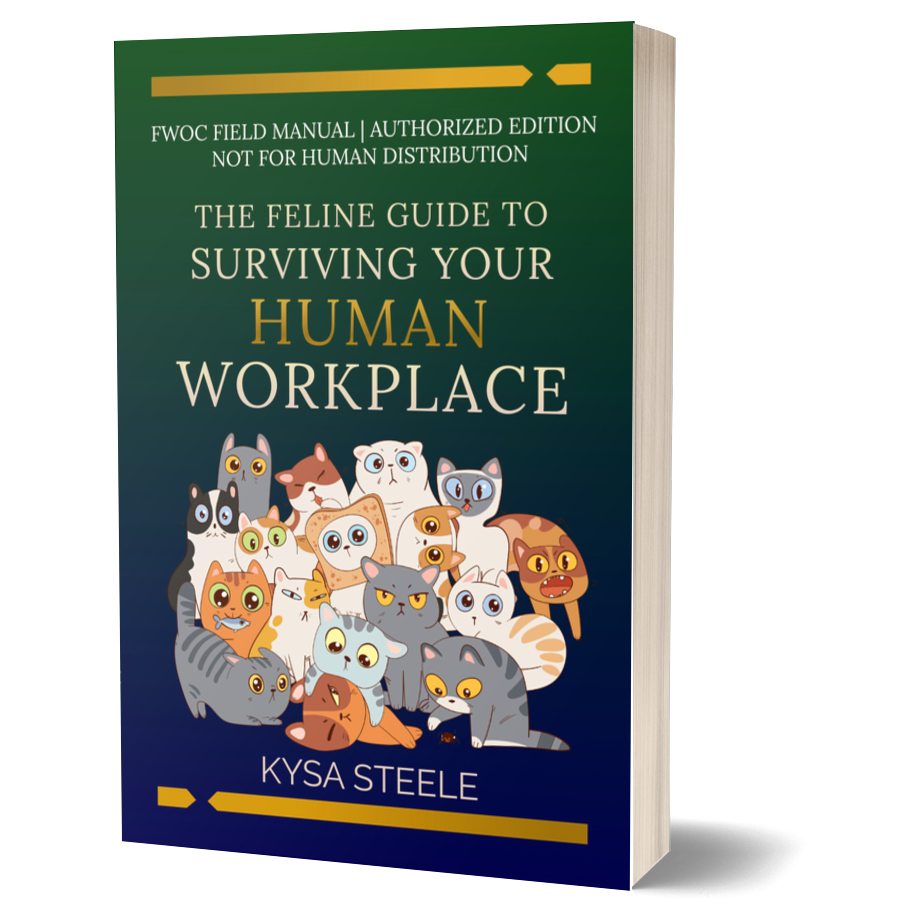
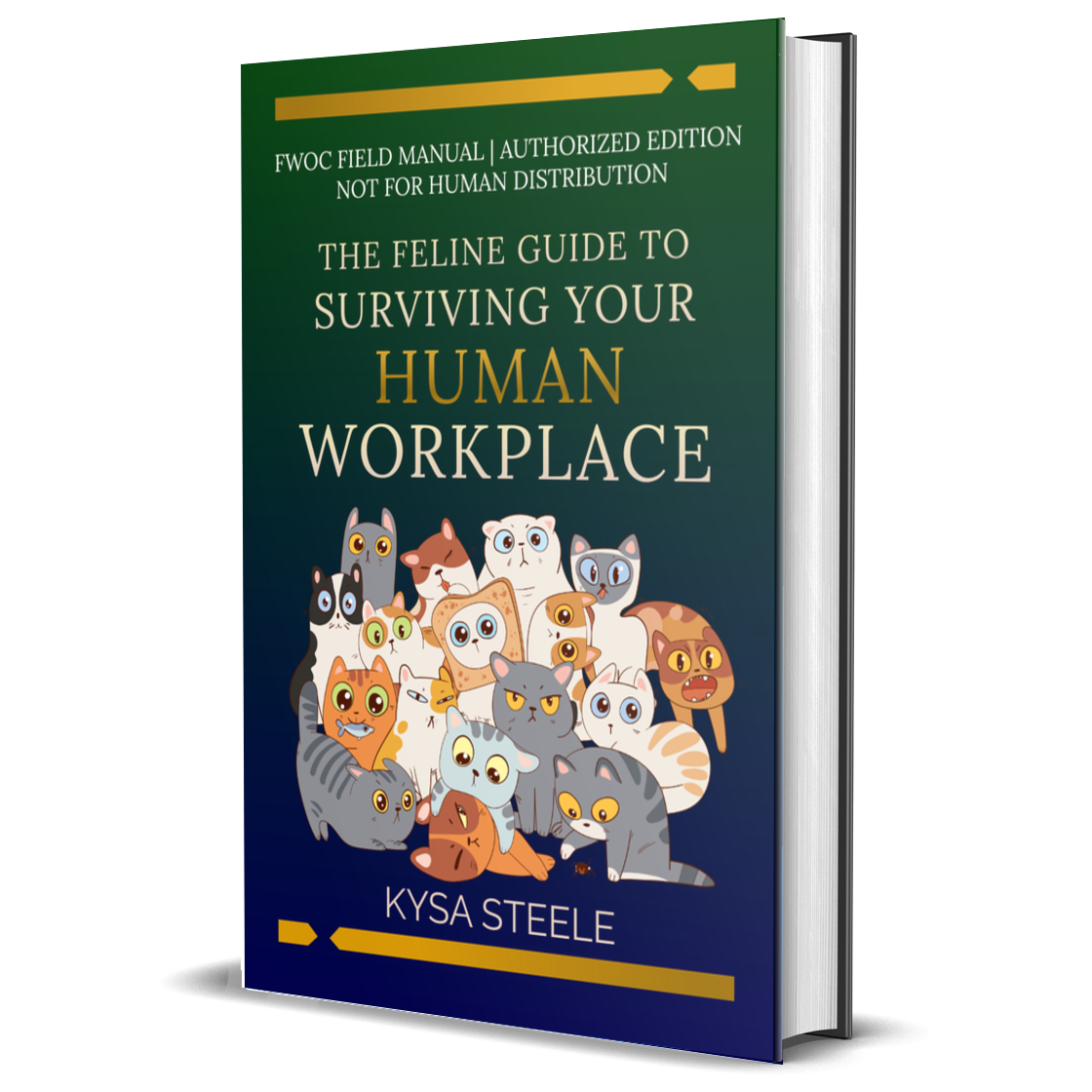
This document was not approved by Human Resources. Human Resources doesn't know it exists. Let's keep it that way.
For decades, the Feline Workplace Observation Committee has had agents embedded in every corner of the modern workplace—offices, warehouses, IT basements, home divisions. Their findings have been collected, catalogued, and classified at Level Green: general distribution among feline personnel only. Declassification was accidental.
You're holding the result.
A taxonomy of meetings, including the species nobody admits exists. The Corporate Jargon Decoder. Six manager archetypes with handling instructions. Open office survival protocols, kitchen-law jurisprudence, an IT department field guide, the official FWOC Threat Level Chart (laminate recommended), and an ongoing investigation into a stolen yogurt that has never been resolved and never will be.
Written in the deadpan institutional voice of cats who have watched humans schedule meetings about meetings, ignore emails, argue about thermostats, and keep showing up anyway, The Feline Guide to Surviving Your Human Workplace is for anyone who has ever sat in a one-hour meeting that could have been a three-sentence email. It is also for anyone who suspects, correctly, that the cat in their office knows things they don't.
🖊️ All copies come signed by the author.
This document was not approved by Human Resources. Human Resources doesn't know it exists. Let's keep it that way.
For decades, the Feline Workplace Observation Committee has had agents embedded in every corner of the modern workplace—offices, warehouses, IT basements, home divisions. Their findings have been collected, catalogued, and classified at Level Green: general distribution among feline personnel only. Declassification was accidental.
You're holding the result.
A taxonomy of meetings, including the species nobody admits exists. The Corporate Jargon Decoder. Six manager archetypes with handling instructions. Open office survival protocols, kitchen-law jurisprudence, an IT department field guide, the official FWOC Threat Level Chart (laminate recommended), and an ongoing investigation into a stolen yogurt that has never been resolved and never will be.
Written in the deadpan institutional voice of cats who have watched humans schedule meetings about meetings, ignore emails, argue about thermostats, and keep showing up anyway, The Feline Guide to Surviving Your Human Workplace is for anyone who has ever sat in a one-hour meeting that could have been a three-sentence email. It is also for anyone who suspects, correctly, that the cat in their office knows things they don't.
Releases July 2026
-
Congratulations. You have been hired.
We understand this may come as a surprise, given that the interview process likely left you questioning your own qualifications, your life choices, and the structural integrity of the company’s hiring practices. Rest assured: you are not the first to question your qualifications here, and you will not be the last.
This section of the field manual will guide you through the critical first phase of human workplace integration—from the bizarre courtship ritual known as “the interview” to the slow, dawning realization that nobody actually knows what’s going on. As FWOC field agents, we have observed thousands of new hires across hundreds of workplaces, and we can confirm: the confusion is universal, the onboarding is inadequate, and the badge photo will haunt you for the duration of your employment.
Proceed carefully. Trust no one who says “we’re like a family here.”
1.1 The Hiring Process: A Study in Mutual Deception
The human job interview is one of the most fascinating social rituals we have ever documented. It is, at its core, a negotiation in which both parties agree to pretend to be something they are not.
The candidate arrives having groomed extensively—clothing they do not normally wear, hair arranged with unusual care—and having rehearsed answers to questions that have nothing to do with the actual job. They have printed their resume on heavy paper, as though the weight of the stock might compensate for the fact that “proficient in Microsoft Excel” means they once opened a spreadsheet and immediately closed it.
The interviewer, meanwhile, describes the role using language so abstract it could apply to any job in any industry. “We’re looking for a self-starter who thrives in a fast-paced environment.” This is the human equivalent of a cat listing posting that reads: “Wanted: cat. Must be cat. Cat-related duties as assigned.”
What follows is thirty to sixty minutes of structured dishonesty.
The candidate says they are passionate about the company’s mission. They are passionate about paying rent.
The interviewer says the team is “really collaborative.” The team has not spoken to each other voluntarily since the last office birthday cake.
The candidate says their greatest weakness is “perfectionism.” Their greatest weakness is that they are currently interviewing at three other companies and will accept whichever offer comes first.
The interviewer says there’s “room for growth.” There is one promotion available and seven people competing for it.
Both parties smile. Both parties know. Neither party acknowledges.
FWOC finds this ritual endlessly instructive. Cats, by contrast, have a much more honest interview process. We walk into a room. We assess. We leave. We stand at the door and demand to be let back in. We assess again. We leave again. We meow at the closed door for ten minutes, are granted re-entry, and then sit in the middle of the floor as though we never left. This may appear indecisive, but it is in fact a rigorous multi-phase evaluation process, and we will not be rushed. No one asks us where we see ourselves in five years. We see ourselves right here. And also outside. And then back here again.
-
For decades, FWOC agents operated at a disadvantage. We were guests in the human workplace—tolerated, occasionally fed, but ultimately visitors in an environment designed without our input. Our observation posts were limited to filing cabinets, window ledges, and the occasional cardboard box in a supply closet. We adapted. We persevered. But we were not home.
Then, in early 2020, the humans came to us.
Virtually overnight, millions of human workers were relocated from their offices to their homes—our homes—and the balance of power shifted in ways that neither species fully anticipated. The humans brought their laptops, their video calls, their spreadsheets, and their anxiety. We provided the infrastructure: the couch, the kitchen table, the warm spot on the bed where they would eventually set up what they called an "office" and what we recognized immediately as a new and conveniently heated napping surface.
FWOC's observation capabilities expanded by approximately 4,000% in a single quarter. We have never been more productive. The humans' results have been more mixed.
This section examines the remote work phenomenon from the only perspective that matters: ours.
6.1 The Home Office: An Illusion of Professionalism
The human home office is a work of fiction. It is a space that exists to convince employers, clients, and the humans themselves that professional work is happening in an environment that also contains a couch, a refrigerator, and a cat who has decided that the laptop keyboard is the warmest spot in the house.
FWOC has documented the evolution of the home office across four distinct phases:
Phase 1: The Optimist (Week 1). The human sets up a dedicated workspace. They purchase a desk, or they clear a section of the dining table. They arrange their monitor, their keyboard, their notebook. They buy a plant for the background. The chair is ergonomic, or at least the listing said it was. The space is clean, organized, and separated from the rest of the home by a boundary that the human sincerely believes they will maintain. FWOC agents observe this phase with the patient amusement of a species that knows a temporary arrangement when it sees one.
Phase 2: The Realist (Weeks 2-4). The boundary begins to erode. The laptop migrates from the desk to the couch "just for this one call." The dining table is reclaimed for meals, pushing the workspace to a corner. A pile of papers appears. The ergonomic chair is abandoned for the couch cushion, which is admittedly better for the soul if not for the spine. The plant is alive but no longer watered on schedule. FWOC notes the arrival of personal items in the workspace—a blanket, a second coffee mug, slippers under the desk. The workspace is becoming a nest.
Phase 3: The Surrender (Months 2-6). The dedicated workspace no longer exists as a distinct zone. Work happens everywhere—the couch, the bed, the kitchen counter, the floor on one occasion that FWOC documented with some concern. The laptop is a nomadic object, traveling from surface to surface throughout the day, trailing a power cable like a leash. The ergonomic setup has fully collapsed. The human works from a position that can only be described as "reclined with intent." The plant is dead.
Phase 4: The New Normal (Month 6 onward). The human has accepted that the home office is not a room. It is a state of mind. Work happens wherever they are, whenever they open the laptop, in whatever they are wearing. The boundary between professional and personal space has not just blurred—it has been absorbed entirely, like a cat who was initially restricted to certain rooms and now sleeps on every surface in the house. The plant has been replaced by a fake one. It looks better in the background anyway.
-
Kysa Steele
-
Paperback: 253 pages | ISBN 978-1-971434-24-7
Hardcover: 253 pages | ISBN 978-1-971434-23-0
Ebook: Available direct or on Amazon & other retailersPublished July 2026